3 stars
**I was provided a physical ARC from the publisher in exchange for honest review.**
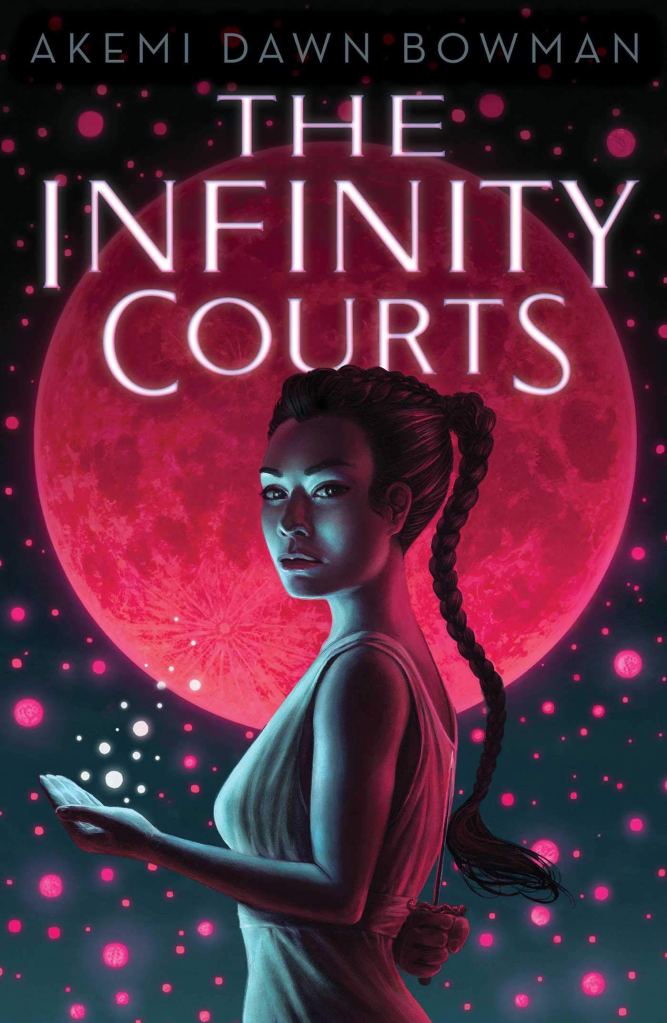
Akemi Dawn Bowman explores what it means to be human in The Infinity Courts. After Nami is murdered, she finds herself in Infinity, a place that was once dreamed by humans for consciousness to go after a physical body has died. However, it is now ruled by an artificially intelligent sentience that is tired of playing servant to humans. Nami must take a side between the humans and AIs, for it does not seem that coexistence is possible.
I had a difficult time with this book. I could tell, objectively, that the construction of the Infinity Courts themselves was interesting. I could identify characters that were ones I would (very late in the book) come to root for. But a combination of factors led to me just feeling a bit mediocre about this book. I found that Bowman chose to be very fast-paced straight out of the gate, which is a common strategy to build a reader’s interest. But I didn’t know enough about Nami to particularly care that she was murdered, and her responses were not ones that endeared me to her. So the fast-pace into a slow build of information was kind of wasted on me.
Nami, as a character, was understandable and spent 90% of the book if not the entirety of the book in a moral dilemma. Which, for me, made her extremely unlikable. Particularly the middle of the book, which really centers around Nami trying to work through her thoughts. I was just frustrated and impatient. Which is not to say her characterization was bad; it was very believable. I found her wishy-washy and unwilling to take a stand, which I dislike in real life as well. Therefore, I was not pleased to be spending the book in her perspective. Which meant when the pace did slow down, I was that much more annoyed which was compiled by the repetitive quality of the running moral dilemma theme.
There were a multitude of other characters that were introduced as side characters, but we really didn’t get to see much of them beyond what role they were meant to fill. It really seemed as though the side characters were simply there to bolster Nami’s purpose rather than being developed in their own right. Which meant that my usual strategy of becoming invested in a side character to carry through a book with a main character I dislike didn’t work for me here.
Objectively, Bowman is exploring very interesting concepts through a world that sounds pretty cool, but I don’t think I was able to appreciate it as much as I might have had there been more character development. I would still reasonably recommend this book to other readers as I’m certain many other people won’t encounter the same issues I did.
 Bumpy Oak Books
Leave a comment